Why Is English Easy to Learn?
Learning a new language takes commitment, motivation and a bit of determination, there’s no getting around that. But English also has a lot going for it. It’s the most spoken language in the world, with around 1.5 billion speakers, roughly one in five people on the planet, and you’re surrounded by chances to hear and use it every day. If well over a billion people have learned English, so can you.
What makes English easier (or harder) for you
Everyone learns differently, but a few things shape how quickly English clicks for you:
- Your motivation. This is the single most important factor. A clear reason to learn, work, travel, study, keeps you going when progress feels slow.
- How close your first language is to English. The more your language shares with English in roots and vocabulary, the more you’ll recognise from the start.
- Whether you already speak other languages. If you grew up multilingual or have learned a language before, picking up English tends to come more easily.
7 reasons English is approachable
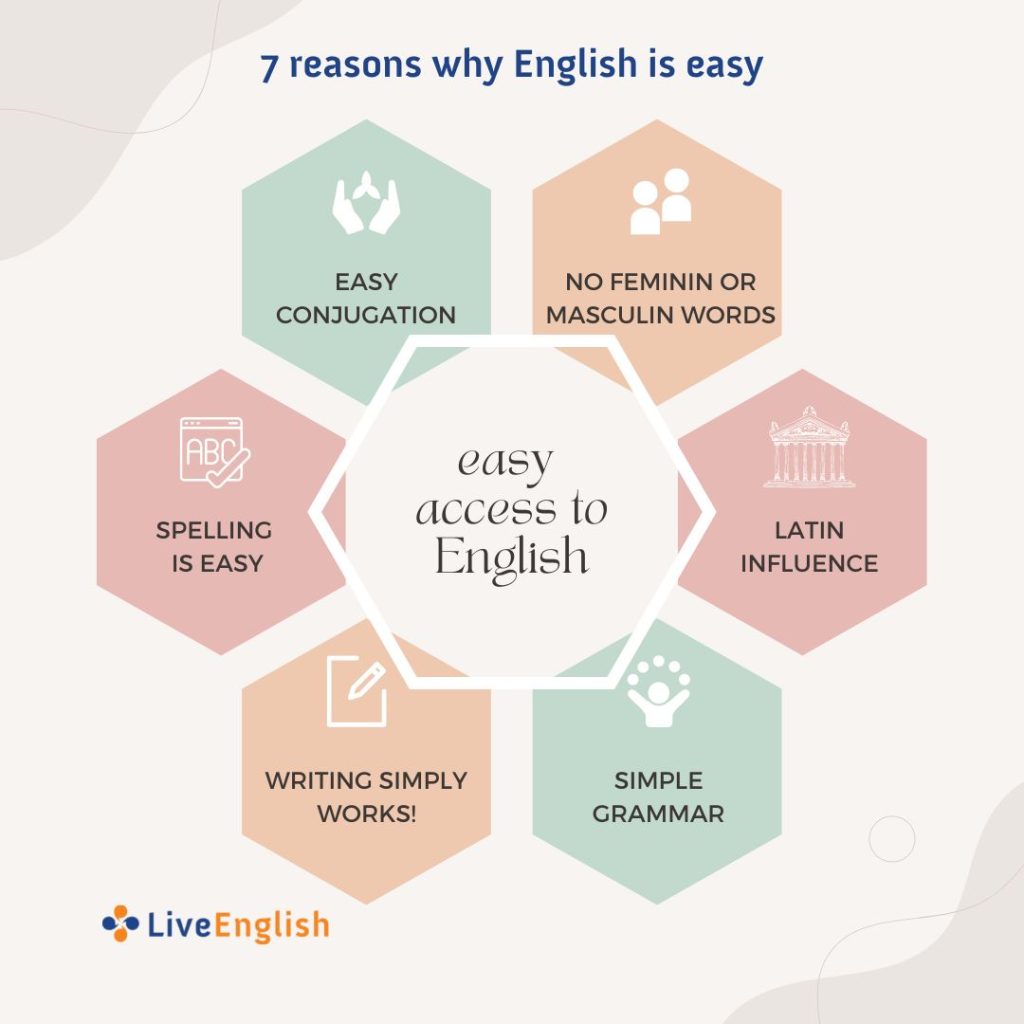
- Simple grammar where it counts. There’s no grammatical gender, and regular verbs barely change: only the third-person singular adds an “s” (she works). Everyday nouns have no complicated case endings, possession simply adds an apostrophe and “s” (the team’s goal).
- Lots of familiar vocabulary. English is Germanic but heavily shaped by Latin and French, so speakers of many languages already recognise thousands of words. And English words like “weekend,” “internet” and “email” have spread into most languages, so you start with more than you think.
- No grammatical gender. Nouns aren’t masculine, feminine or neuter, so you never have to memorise a gender for every single word.
- Few verb forms. Compared with many languages, English has relatively few conjugations. The verb usually stays the same across persons, with only that third-person “s” or “es” to remember.
- Simple usually wins. Clear, short sentences are good English. You don’t need elaborate constructions to sound fluent, plain and direct is exactly right.
- A short alphabet. Just 26 letters. Spelling can be irregular because the sounds don’t always match the letters, but there are clear patterns, and learning them ties your reading and speaking together.
- Endless exposure. Films, series, music, podcasts and the whole internet are full of English. You can immerse yourself for free, a little every day.
The easiest way to make English stick: practise it
The internet is full of English you can read, watch and listen to, find topics that genuinely interest you and you’ll practise without it feeling like work. But the single thing that speeds everything up is speaking. At Live English, we believe the more you practise out loud, the easier English becomes.
Our Spoken English Courses, by Zoom or your preferred platform, are built around exactly that. Lessons are tailored to your level and your interests, and they’re a full immersion: English is the only language spoken in class, as if you’d stepped into an English-speaking country for an hour. Our native teachers keep you motivated and help you apply the grammar while you speak, which is what makes learners progress so much faster.
Try a free lesson with one of our experienced native English teachers and feel your glass go from half empty to more than half full. Live English has helped over 10,000 learners speak more confidently since 2007. Your first trial lesson is free, no credit card needed. What are you waiting for?
Frequently Asked Questions
Is English easy or hard to learn?
How long does it take to learn English?
What is the hardest part of learning English?
What is the fastest way to learn English?
Can I learn English if I’m not “good at languages”?
Learning English is a marathon, not a sprint, but it’s a friendlier one than most. Keep a positive attitude, get plenty of exposure, and practise speaking, and you’ll find your glass is more than half full.