What Is the CAE Exam (Cambridge C1 Advanced)?
The Certificate in Advanced English, known as the CAE exam or Cambridge C1 Advanced, is one of the most widely recognized English qualifications in the world. Universities use it for admission, immigration authorities in the UK and Australia accept it as proof of language ability, and employers use it to check whether a candidate can work comfortably in English at a professional level. If you pass, you hold a certificate that proves you have reached C1 on the Common European Framework of Reference (CEFR), the level just below full native-like fluency.
The 4 papers of the CAE exam
The current CAE format has 4 papers that test 5 skills. Here is how the marks break down.
| Paper | Length | Weight | What it tests |
|---|---|---|---|
| Reading and Use of English | 1h 30min | 40% | 8 parts, 56 questions: reading comprehension plus grammar and vocabulary control |
| Writing | 1h 30min | 20% | 1 compulsory essay plus 1 chosen task (letter, email, report, review or proposal) |
| Listening | 40 minutes | 20% | 4 parts, 30 questions, each recording played twice |
| Speaking | 15 minutes | 20% | 4 parts, taken with another candidate in front of 2 examiners |
The Reading and Use of English paper carries the most weight, so it deserves the most practice time. It combines two skills in one 90-minute sitting: understanding long, dense texts (magazine articles, journals, brochures) and controlling grammar and vocabulary precisely enough to complete gapped sentences, word-formation tasks and key-word transformations.
Writing paper: what examiners look for
Part 1 is always an essay based on two short texts you’re given, so you can’t prepare a memorized answer. You need to summarise, compare and give your own opinion in 220 to 260 words. Part 2 gives you a choice of three tasks (an email, a report, a review or a proposal, depending on the exam session) and you write another 220 to 260 words. Examiners mark on content, communicative achievement, organisation and language, so a well-structured answer with clear paragraphs and a range of grammar will always beat a longer, disorganised one.
Speaking paper: the 4 parts
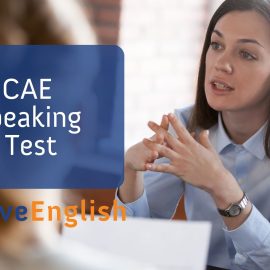
The Speaking test is taken with one other candidate and assessed by two examiners, one of whom asks the questions while the other listens and scores. It has 4 parts: a short interview about yourself (2 minutes), a “long turn” where you compare two photographs and answer a question on your own (4 minutes), a collaborative task where you and the other candidate discuss a problem together and try to reach a decision (4 minutes), and a final discussion where the examiner asks both of you broader questions related to the collaborative task (5 minutes). Many candidates find the collaborative task the hardest, not because their English is weak, but because they aren’t used to negotiating and disagreeing politely in English.
How the CAE exam is graded
Results are reported on the Cambridge English Scale, from 142 to 210. A score of 200 to 210 (Grade A) doesn’t just pass CAE, it awards you the Certificate of Proficiency in English (C2) as a bonus. A score of 180 to 199 (Grade B or C) passes at C1, the level the exam is designed for. A score of 160 to 179 doesn’t fail you outright either: you still receive a certificate confirming B2 First level. This grading structure means it’s genuinely difficult to walk away from the exam with nothing to show for your preparation.
How to prepare for the CAE exam
Self-study with a good preparation book will get you familiar with the question types, but most candidates who take the exam with a teacher score higher, mainly because a teacher gives you immediate, specific feedback on your Writing and Speaking, which are impossible to grade accurately by yourself. A teacher can also spot patterns in your mistakes (a grammar structure you consistently avoid, a pronunciation habit that costs you marks) that you would never notice on your own. If you’re taking the paper-based version of the exam, practise your handwriting too: examiners who struggle to read an answer tend to mark it lower, simply because they can’t reward what they can’t read clearly.
If you want structured, ongoing feedback on your Writing and Speaking rather than working through a book alone, our English exam preparation course pairs you with a teacher who has trained candidates for CAE and other Cambridge exams. For general fluency work before you commit to a specific exam paper, our spoken English course is also a strong starting point, and many candidates preparing for CAE also work through our guides to the CAE Use of English section and CAE Writing section in more depth.
Frequently asked questions
What level is the CAE exam?
How long does it take to prepare for CAE?
What happens if I don’t pass CAE?
Can I take CAE online or does it have to be in a test centre?
Join 10,000+ professionals who have trusted Live English since 2007. Book a free trial lesson, no credit card required.