Australian English vs American English
Like any language, English changes depending on where it’s spoken. Talk to an American and an Australian and, beyond the accent, you’ll hear different words for the very same thing, plus a few differences in spelling. Here’s a clear rundown of how Australian and American English compare, in vocabulary, accent and spelling, so nothing catches you out.
Australian vs American vocabulary
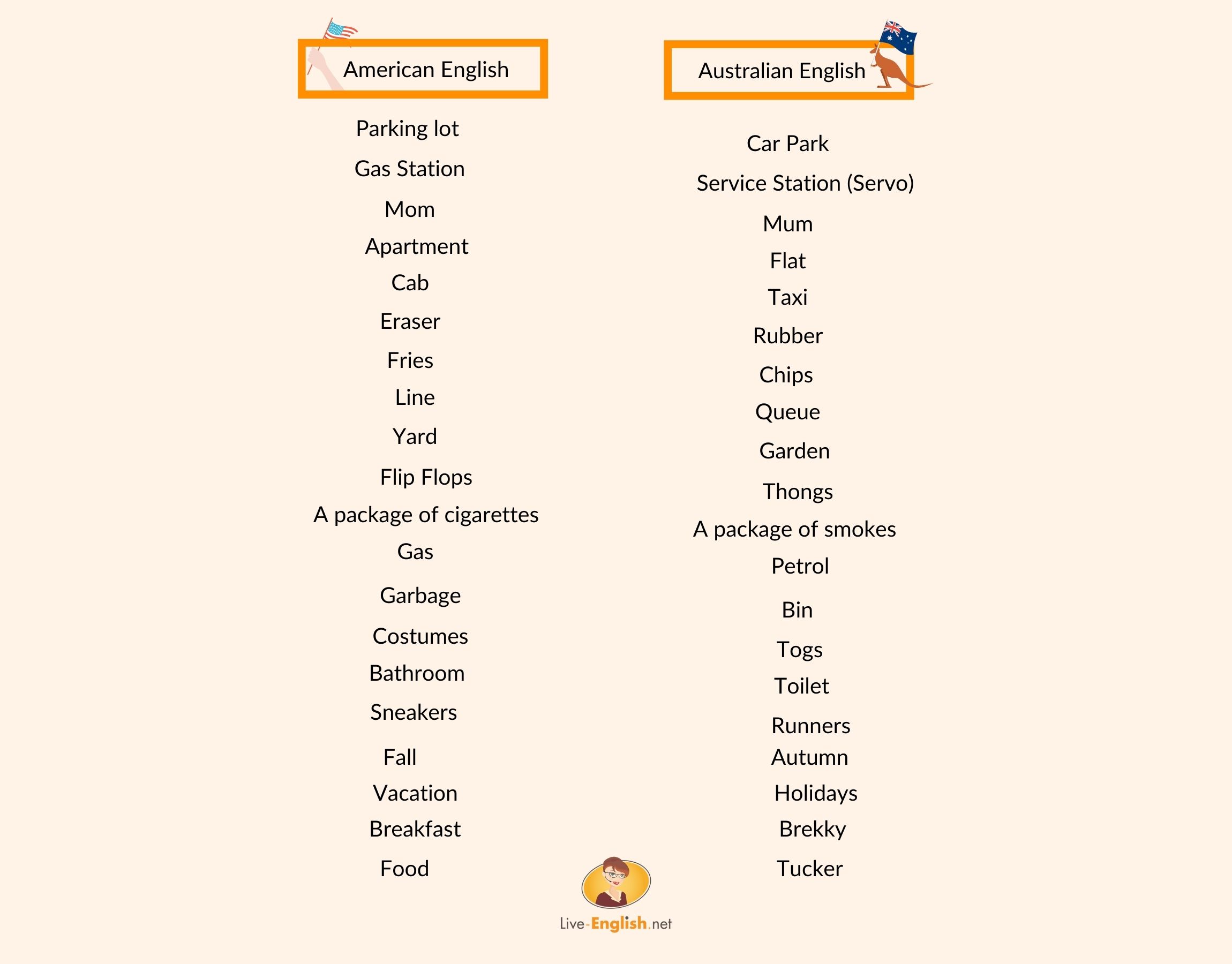
Australian English is closer to British English, but some words are uniquely Australian. Here are 20 common terms with their American equivalents and what they mean.
One thing you’ll notice straight away is the Australian love of shortening words. Australians take a longer word, trim it down and add an “-o”, “-ie” or “-y” on the end: afternoon becomes arvo, breakfast becomes brekkie, a service station becomes a servo, sunglasses become sunnies, a mosquito becomes a mozzie, and a barbecue becomes a barbie. It’s a friendly, casual habit that runs right through everyday speech, and once you spot the pattern, a lot of Australian slang suddenly clicks into place.
| Australian English | American English | Meaning |
|---|---|---|
| arvo | afternoon | the afternoon |
| barbie | grill / BBQ | a barbecue |
| thongs | flip-flops | rubber sandals |
| servo | gas station | a service / petrol station |
| brekkie | breakfast | breakfast |
| mozzie | mosquito | a mosquito |
| sunnies | sunglasses | sunglasses |
| ute | pickup truck | a utility vehicle |
| esky | cooler | a portable cool box |
| chook | chicken | a chicken (the bird) |
| doona | comforter | a duvet |
| lolly | candy | a sweet |
| capsicum | bell pepper | a pepper (vegetable) |
| footpath | sidewalk | the pavement |
| boot (of a car) | trunk | the car’s storage space |
| bonnet | hood | the front cover of a car |
| petrol | gas / gasoline | car fuel |
| lift | elevator | an elevator |
| heaps | a lot / tons | a large amount |
| g’day | hi / hey | a casual hello |
Accent differences
The accent is usually the first thing you notice, and the two go about it quite differently:
- The “r” sound. Australian English is non-rhotic, like British English: the “r” at the end of a word (car, here, mother) goes almost silent. American English is rhotic and pronounces that “r” clearly.
- Vowel sounds. Many vowels differ. The “a” in words like dance and path is broader in Australian English, and the Australian long “a” (as in mate) sounds noticeably different to American ears.
- Rising intonation. Australians often let the pitch rise at the end of a statement, which can make a sentence sound a little like a question.
- The flap-T. Americans soften a “t” between vowels into a quick “d,” so water sounds like “wadder.” Australians soften it too, but the overall rhythm and vowels still sound distinct.
Spelling differences
Because Australian English follows British conventions, its spelling differs from American English in predictable ways:
| Australian (British) spelling | American spelling |
|---|---|
| colour, favour, behaviour | color, favor, behavior |
| organise, realise, recognise | organize, realize, recognize |
| centre, theatre, metre | center, theater, meter |
| travelling, cancelled | traveling, canceled |
Frequently Asked Questions
Is Australian English closer to British or American English?
What are the main differences between Australian and American English?
Can Americans and Australians understand each other?
Does Australian English use British or American spelling?
Which English should I learn, Australian or American?
English is fascinating once you start hearing its varieties. If you’d like to understand the subtleties of Australian, British and American English and more, our mixed-accents conversation course pairs you with experienced native teachers of many nationalities, Australian, British, American and others, so your ear gets used to all of them. Your first trial lesson is free, no credit card needed, and includes an assessment of your level and goals.
Whether you’re heading Down Under or just curious, knowing these differences makes English a little more fun, and a lot easier to follow wherever the conversation comes from.