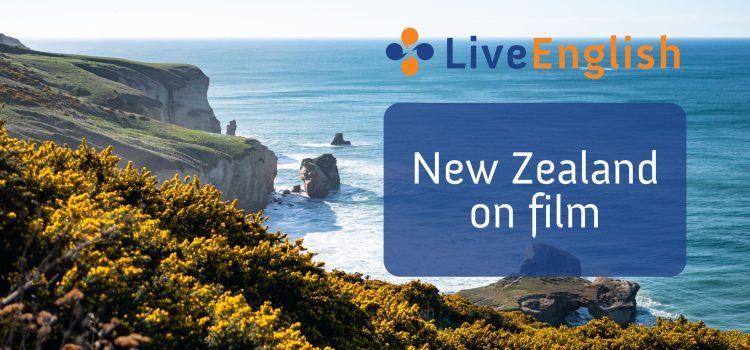
New Zealand on Film
Have you ever been to New Zealand? It is a small country in the South Pacific with roughly the same population as Ireland, and yet it has produced a film industry that gave us names like Peter Jackson (Lord of the Rings, King Kong and The Hobbit), Sam Neill (Jurassic Park, Merlin) and Anna Paquin (True Blood, Fly Away Home). Watching films from a country is one of the most enjoyable ways to learn about its culture and to train your ear in English at the same time.
Top five New Zealand films
Here are five of the best New Zealand movies, in my humble opinion. Try watching one with English subtitles first, then again without, to see how much more you understand the second time.
Utu (1983)
Screened at the 1983 Cannes Film Festival, Utu was said to have the largest budget of any New Zealand movie of its time. It is set during the days of British colonisation and explores the relationship between settlers and the Maori people. Director Geoff Murphy also made other iconic films such as Goodbye Pork Pie and The Quiet Earth.
Bad Taste (1987)
In 1987, a young Peter Jackson was just starting out. He made this movie on weekends, playing two roles himself and enlisting friends and coworkers for the rest. It was filmed mostly at his house, and the whole thing was made for under NZ$25,000. Bad Taste, Meet the Feebles and Braindead are the low-budget horror movies that launched his career, and they are arguably the best low-budget horror films ever made.
Once Were Warriors (1994)
Once Were Warriors is a hard film to watch, dealing with alcoholism, poverty and domestic violence. It was hugely popular thanks to its powerful portrayal of an urban Maori family, and it made a star of Temuera Morrison, who went on to Hollywood roles in Star Wars and Speed 2.
The Piano (1993)
The Piano won the Palme d’Or at Cannes and remains one of the most widely circulated and critically acclaimed New Zealand films ever made. Its quiet, emotional storytelling makes it a good choice for intermediate learners who want dialogue that is clear and not too fast.
Whale Rider (2003)
Whale Rider debuted at the Toronto International Film Festival and is a moving story of a young Maori girl who wants to lead her community. Both this film and The Piano are well worth a watch, and both are gentle enough to follow even if English is not your first language.
Why films are great for learning English
Films give you natural speech, real accents and useful everyday vocabulary in context. You hear how people actually talk, including slang, tone and rhythm that a textbook cannot teach. Because the story pulls you along, you stay engaged for longer than you would with a grammar exercise, and you pick up phrases without even trying.
Useful English phrases for talking about films
Once you have watched a movie, being able to discuss it is great speaking practice. Keep these English phrases as they are and use them in your next conversation class or with friends.
| Situation | What you can say |
|---|---|
| Recommending a film | “You should really watch it. It’s well worth a look.” |
| Giving your opinion | “I thought the acting was brilliant, but the ending fell a bit flat.” |
| Describing the plot | “It’s set during the colonial era and follows two families.” |
| Asking for a recommendation | “Can you recommend a good film to practise my listening?” |
Keep exploring through travel and culture
If New Zealand film has you dreaming of far-off places, you might enjoy our guide to adventure in Scotland or our tour of the American National Parks. And when you are ready to turn all that listening into confident speaking, our conversation course with a mix of accents pairs you with a native teacher who can turn your favourite films into real conversation practice.
Are films really useful for learning English?
Should I use subtitles when watching films in English?
Which New Zealand film is best for beginners?
How can I remember new words I learn from films?
Turn films into fluent conversation
Practise speaking about the movies and stories you love with a native English teacher.